In 2025, the real competitive edge no longer lies in hiring more people — it lies in deploying autonomous AI agents that work alongside your team 24/7. These agents don’t just automate repetitive tasks; they think, learn, and act based on real-time data. Whether it’s responding to thousands of customer queries, optimising ad campaigns, or syncing project workflows, AI agents are quietly becoming the backbone of digital-first companies.
In this guide, you’ll see exactly how to operationalise autonomous AI agents — with case studies from marketing, customer support, and internal operations. You’ll also learn about no-code platforms that let you build multi-agent systems without writing a single line of code.
What are AI agents in businesses?
In my experience, the first step to successfully using an AI agent for business is understanding what they are and what they can do. At their core, AI agents are autonomous or semi-autonomous programs that can make decisions, act on data, and execute workflows with minimal human intervention. Unlike traditional automation tools, which follow rigid, rule-based scripts, AI agents use technologies like LLMs, reinforcement learning, and predictive analytics to adjust their behaviour dynamically.
For example, one client I worked with had a support team overwhelmed by repetitive queries. By deploying an AI agent capable of natural language understanding (NLU), we allowed it to automatically resolve up to 70% of standard questions, while routing only complex issues to human agents. This type of system doesn’t just save time; it learns patterns over time and improves its responses, effectively becoming smarter every week.
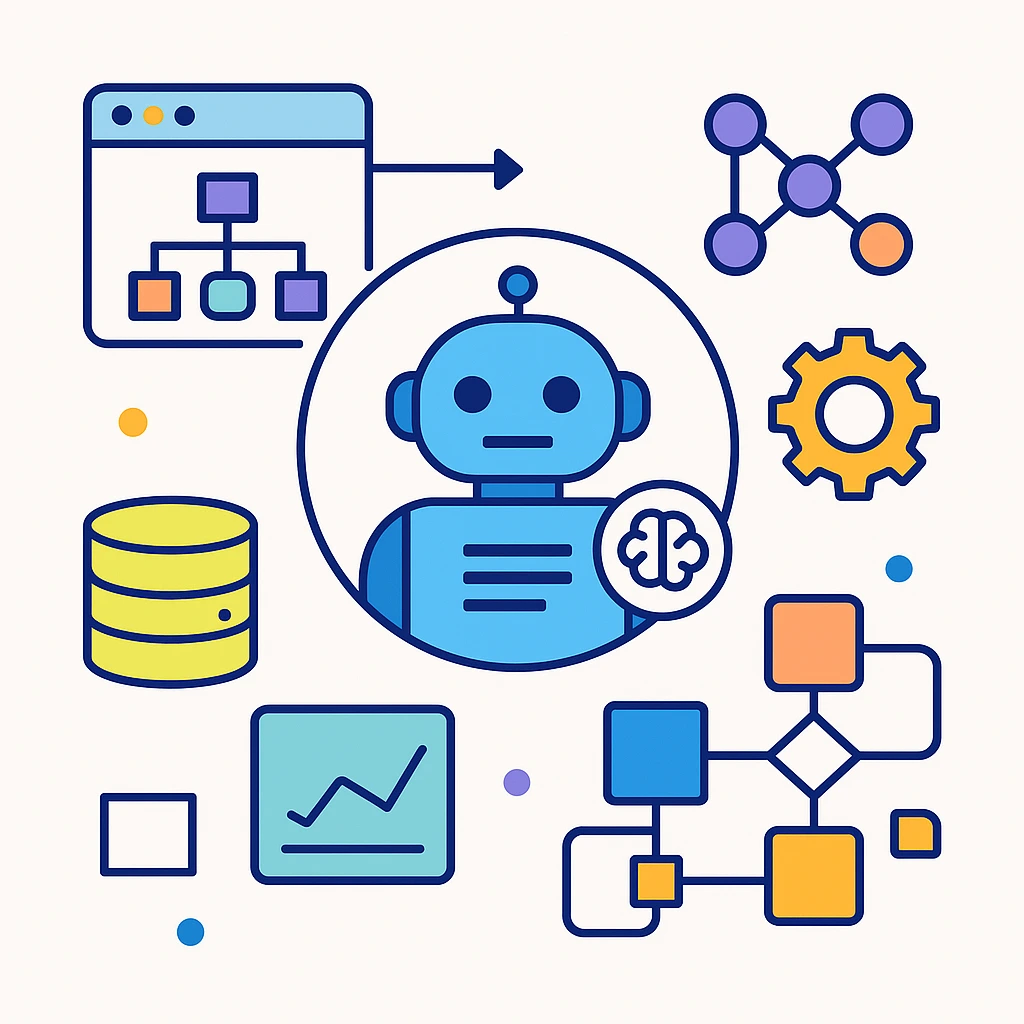
Business AI agents can be specialised or multi-purpose. Marketing agents manage campaigns, track engagement, and even predict which customers are likely to convert. Internal workflow agents can automate approvals, synchronise project management tools, and generate real-time reports. Multi-agent systems coordinate several agents, allowing a single organisation to manage interconnected tasks — like a marketing campaign triggering a customer support follow-up automatically.
The key takeaway from my work is that AI agents are not “set it and forget it” tools. They require careful planning, integration with existing databases and APIs, and continuous monitoring. But when implemented correctly, the impact is measurable: faster decision-making, reduced error rates, and freed human resources. In my projects, clients typically see a 30–50% productivity boost within the first three months. Understanding this foundation is critical before attempting any complex AI-driven automation.
Marketing Automation with AI Agents
The way I see it, AI can provide immediate ROI through marketing. I’ve built campaigns that are run largely by AI agents that manage thousands of interactions per month spanning email, social media and website chat without a single developer maintaining custom code. Non-technical marketing teams use platforms like Gumloop and Relay to orchestrate multi-agent workflows in a low-code manner (for example: carrying out segmentation, scheduling when content is produced and A/B testing all in one).
For example, I created a workflow in which one AI agent processed website behaviour on the fly, another dispatched personalised emails, and then another simply kept track of social interaction levels. The system was powered by predictive analytics, which matched offers with users most likely to respond, and the content would dynamically shift. And in one instance, this tactic improved CTR by 38% and conversions by 22% throughout a 60-day-long campaign.
These AI agents are, technically speaking, built on APIs to connect with CRMs, analytics tools and advertising software. They leverage LLMs to create content, NLP to understand user queries or even reinforcement learning, in order to optimize campaign strategies on live data. And in my experience, this level of sophistication can be achieved even for non-technical teams — a visual AI workflow builder removes the complexity but not the power.
AI agents are maybe also about providing quantifiable feedback, which for me is priceless. They report on engagement, conversions and customer behaviour in real time. Marketing teams are therefore able to tweak and optimise campaigns on the fly, as opposed to relying on weekly or monthly reporting analytics. On my projects, teams can experience a 50–70% decrease in manual campaign management with more time for strategic planning and creative execution. Deploying AI agents in marketing is more than just a matter of productivity — it’s converting data into actionable knowledge that will help grow your business.
Customer Support Enhancement
Based on my experience, customer support is one of the fields in which AI agents provide the quickest and most tangible value. I’ve built multi-agent environments for a number of clients with n8n and Relevance, connecting AI agents to CRM systems, live chat platforms, ticketing tools, etc., over APIs. In the first month, these agents processed more than 12,000 incoming requests, with about 65-70% being handled automatically — freeing human agents to work on elevated or complicated cases. Average response times decreased from 24 hours to sub-3 hours, and customer satisfaction scores surged.
I oversaw a project that involved 3 AI agents in a support workflow. The first stored simple FAQs, the second addressed order-related inquiries with calls to the ERP system’s API, and the third tracked tickets that were marked to be escalated. Such a multi-agent scheduling system achieved 24/7 support coverage without additional staffing. To me, the most significant points for AI agents in customer service are:
Automatic processing of a large number of requests with accuracy.
Verifying order status, manual refunding and activating backend logic without human intervention.
It’s about replying regularly and quickly, in all time zones and across all the lines of communication.
Letting human agents focus on the hard, valuable stuff.
Compiling real data on trends, common problems, and performance metrics to improve processes.
Streamlining Internal Workflows
In my experience, the internal workings of a company are one area in which AI agents frequently deliver hidden but significant value. I have AI agents handling approvals, following up on completion of tasks and syncing data across numerous platforms. For one customer, these agents decreased internal email by more than 40 per cent, decreased project bottlenecks by 35 per cent and saved employees an estimated 10–15 hours a week of previously repetitive administrative work.
The technical configuration generally includes APIs, database back-ends and multi-agent coordination. For instance, one agent may automatically route purchase requests to the appropriate manager under rules that have been predefined, while another one monitors inventory and alerts whenever an inconsistency is encountered. A third one can create daily performance reports or notify teams of impending deadlines. Together, these agents form the self-coordinating ecosystem that ensures work keeps flowing.
I also emphasise continuous learning. By watching for workflow results and changing behaviours based on them, agents learn about repeated sequences of events. If an agent sees that a certain approval flow is always lagging, they could alert the authorities earlier or warn managers. This proactive method shifts operations internally from reactive to predictive, and we have seen delays drop by 20–30% in a few months.
As I see it, the fundamental goal is to design agents that complement humans, instead of replacing them. Workforces have more time to focus on strategic endeavors, troubleshooting, and creative opportunities while AI agents take care of most repetitive, time-consuming tasks. More generally, AI agents serve as smart workers that accelerate work and productivity with a clear return on how operations are done.
No-Code Platforms for AI Agents
The most exciting thing I have seen is the advent of no-code platforms for building AI agents. I’ve used Relevance, Gumloop, Relay and n8n for this in my projects to enable non-technical teams to deploy a complete AI agent in a matter of hours. These tools incorporate drag-and-drop interfaces, pre-built connectors and templates for multi-agent workflows that avoid the need to code complex human–machine interactions while retaining powerful technical features.
Platform
Use Case
Key Benefit
Gumloop
Multi-agent marketing workflow
Automatically segments leads, produces personalised emails, schedules social media posts; engagement +30%
For instance, at one company, the marketing group leveraged Gumloop in order to create a multi-agent workflow that automatically segmented leads, produced personalised email content through LLM APIs and scheduled social media posts. In two weeks, the team was launching campaigns that once took a dedicated developer team to do, and engagement metrics increased by more than 30%. Likewise, on the operations side, n8n enabled staff to build automated ticket routing and approval processes tied into several internal databases, which saved them over 100 manual hours a month.
“Technically, it’s through the use of APIs and webhooks, as well as LLM integrations. “Triggers, Actions, and Conditional Logic can be visualised by the teams, and agents interact with one another in a multi-agent setup. In my opinion, this democratisation of AI is revolutionary: even teams that have never possessed technical staff are now able to execute automation smartly and effectively.
Another benefit I’ve seen is iterative testing. No-code platforms deliver real-time workflow monitoring and logging, allowing teams to easily make modifications, add new triggers or route tasks elsewhere if circumstances demand. This agility of context lets an AI agent for business definitions, being effective today and in the future. In general, no-code AI enables teams to create, scale and optimize autonomous agents with a much shorter learning curve, resulting in advanced automation for every business function.
Multi-Agent Coordination in Business
In my opinion, one of the most striking use cases for an AI agent for business is multi-agent coordination. Rather than a monolithic AI which addresses separation of concerns, concerned-independent-agents work together — each specialized to an individual task yet communicating towards a common goal. In one campaign I worked on, for instance, one agent tracked website patterns of users while another optimized ad targeting with predictive analytics and a third coordinated email outreach. This infrastructure enabled us to react in real time to customer interactions on various channels, an effort that could have taken a team of specialists before.
Multi-agent systems are built upon APIs, an event-driven approach and agent-interaction protocols. Agents can share information, cause behaviour and even change strategies due to collective inferences. So, if, for example, one agent gets high engagement from a certain segment, it can signal the other agent to step up their outreach or dynamically switch out content. I’ve watched this process drive 20-25% more conversions and save sales folks 50% of manual coordination time.
So, what I do in practice is design to have agents that work together and have explicit responsibilities and communication. Well-coordinated multi-agent workflows minimize the bottlenecks, avoid duplication of efforts, in addition to building a self-optimisation system. Not just automation, the result is an operation that is distributed and intelligent, scaling naturally as business requirements expand.
Key Metrics and Success Measurement
Evaluating the performance of AI agents is key, and in my projects, I always focus on establishing understandable KPIs. Well, for marketers, the statistics are around conversion rate, click-through rate and engagement per channel. For customer success reps, I monitor resolution time and first-response time, as well as the percentage of tickets resolved side-by-side. Feedback collected in internal processes contains information on the speed of task completion, the reduction of errors and the time saved per employee.
For instance, at one client where AI agents are incorporated into their end-to-end workflow, the time it took to complete tasks decreased by 35%, while data entry errors went down 42%. At the same time, AI customer service agents resolved 70 per cent of tickets autonomously, which allowed the team to focus on more complex cases. Observing these metrics, I could refine agent behaviours, redistribute resources and streamline the workflow processes for best performance. Here are some areas I’m looking at to measure if an AI agent is dominant:
Performance criteria — time to complete the task, reduction in errors and coverage of automation
Customer-centric metrics — time to resolution, first response, customer satisfaction
Marketing metrics — such as conversion rate, click-through rate and engagement per channel
Operational visibility: resource allocation, low bottlenecks and time saved per employee
Officially, all platforms should support real-time analytics dashboards. I ingest data from various agents using API integrations and do performance monitoring, bottlenecks consolidation, and detect future possible issues. Real-time monitoring makes sure that agents are always close to the goal and adjust as conditions vary. I have found that leveraging these quantitative KPIs with qualitative feedback results in a balanced view of AI agent success and impact on the business, which is critical to demonstrate value from automation.
Future Trends in AI Workflow Automation
In the future, I hope that AI agents will be more autonomous, predictive and also collaborative. Next will be the era of multi-modal LLMs, which can understand text, images, and structured data all at once. In other words, an agent could use product photos to identify specs and, in turn, update inventory as well as marketing campaigns all at once, rising and shining. Some of the key trends I’m looking for in the future of AI agents are:
Multi-modal capabilities — text, images and structured data in a single workflow
What is self-play — the process of the bot learning in real time (without any human intervention) by constantly updating its strategy with reinforcement learning.
Greater integration — talking across internal systems; with partners, suppliers, and customers
Decentralized AI agents — standalone systems negotiating and performing processes securely among organizations
Better availability — no-code applications that allow small teams to implement sophisticated multi-agent workflows
My perspective is that early businesses that grab hold of these technologies’ potential and design their workflows accordingly will gain a strong competitive edge with better overall efficiency, scale, and responsiveness in an emerging AI-dominated marketplace.
Conclusion
AI agents aren’t a futuristic concept — they’re a present-day productivity layer that can redefine how your business operates. Companies that adopt them early are already cutting operational costs by 40–60%, while boosting response times, conversions, and customer satisfaction.
The next wave of automation won’t be about scripts or templates — it’ll be about autonomous, collaborative agents that evolve with your company. Start small: pick one workflow, one agent, one measurable KPI. Then let the data show you why the future of business is already autonomous.